
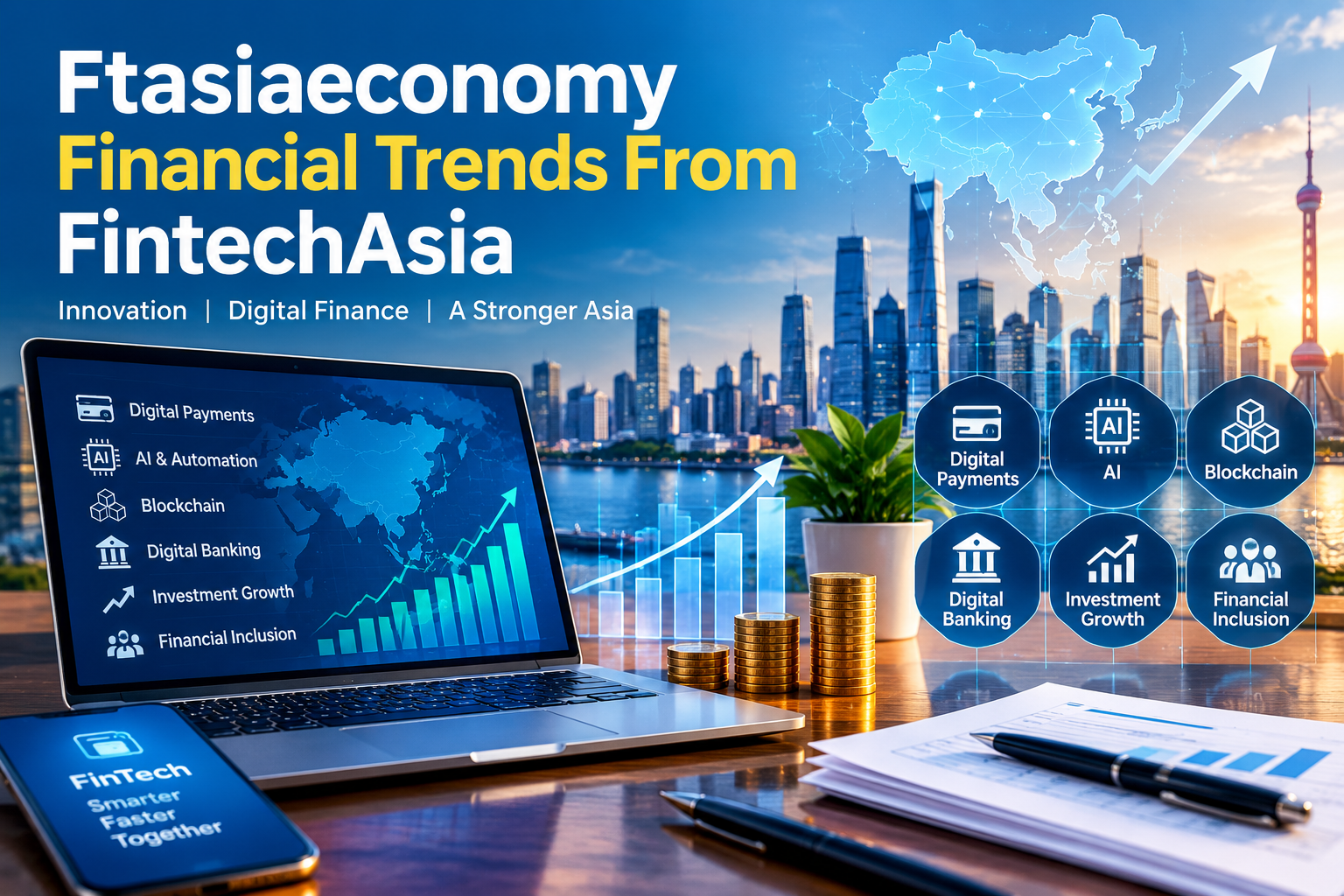
The financial landscape across Asia is changing rapidly as technology, digital payments, investment platforms, and innovative banking services reshape how individuals and businesses manage money. As financial institutions adopt new technologies, readers and businesses are increasingly interested in reliable information about market movements, fintech developments, and emerging economic opportunities. In this environment, ftasiaeconomy financial trends from fintechasia can provide a useful perspective on the relationship between financial innovation and broader economic developments.
Understanding these trends is important for businesses, investors, technology professionals, and everyday consumers. Financial technology is no longer limited to mobile banking applications. It now covers digital wallets, artificial intelligence, blockchain, online lending, automated investment tools, cybersecurity, and data-driven financial services. Together, these developments are influencing the direction of modern economies.
The Growing Role of Fintech in Asian Economies
Fintech has become an important part of the financial ecosystem throughout Asia. Traditional financial institutions are increasingly working with technology companies to provide faster and more convenient services. At the same time, fintech startups are introducing products designed around mobile devices and digital-first customers.
One major change is the expansion of digital payments. Consumers can now pay for goods and services through mobile applications, QR codes, online banking platforms, and digital wallets. This shift has helped businesses serve customers more efficiently while creating new opportunities for financial inclusion.
The growth of digital financial services is also encouraging companies to invest in better infrastructure. Cloud computing, artificial intelligence, cybersecurity systems, and advanced analytics are becoming increasingly important components of financial operations.
Digital Payments Continue to Expand
Digital payments remain one of the most visible financial technology trends. Consumers increasingly expect payment systems to be fast, secure, and easy to use. Businesses are responding by offering multiple digital payment options.
For smaller businesses, digital payments can reduce dependence on cash and simplify transaction management. Online payment records can also make it easier to monitor sales, prepare financial reports, and understand customer behavior.
Financial institutions are similarly investing in payment technology. Faster transactions and improved mobile experiences can help banks remain competitive as customers become more comfortable with technology-based financial services.
These developments are an important part of ftasiaeconomy financial trends from fintechasia, particularly because payment innovation connects technology with everyday economic activity.
Artificial Intelligence and Financial Services
Artificial intelligence is becoming another major force in the financial industry. Banks and fintech companies are using AI to analyze large amounts of information, improve customer support, detect unusual transactions, and automate repetitive processes.
AI-powered chatbots can answer common customer questions, while machine-learning systems can help identify potentially fraudulent activity. Financial institutions can also use data analysis to develop more personalized products and services.
However, AI adoption also creates challenges. Financial organizations must consider data privacy, cybersecurity, accuracy, transparency, and regulatory requirements. The effectiveness of AI depends heavily on the quality of the information used to train and operate these systems.
As adoption continues, financial companies will likely focus on finding a balance between automation and human oversight.
The Evolution of Digital Banking
Digital banking has changed customer expectations. Many customers now want to open accounts, transfer money, check balances, apply for financial products, and communicate with service providers without visiting a physical branch.
Mobile banking applications have therefore become central to the customer experience. Banks are improving their applications with biometric authentication, instant notifications, digital onboarding, and integrated payment features.
This transformation does not necessarily mean traditional banks will disappear. Instead, many institutions are combining established financial expertise with modern technology. Partnerships between banks and fintech companies can allow organizations to develop new services without completely rebuilding their existing infrastructure.
Financial Inclusion and Accessibility
One of the most important potential benefits of fintech is greater financial inclusion. Technology can make financial services accessible to people who may have previously faced difficulties accessing traditional banking.
Mobile-based services can reduce geographical barriers and provide basic financial tools to customers in underserved communities. Digital wallets, online transfers, and alternative financial platforms can make it easier for individuals and small businesses to participate in the formal economy.
However, digital inclusion requires more than simply providing applications. Customers also need affordable internet access, digital literacy, appropriate security measures, and confidence in financial technology.
For this reason, financial inclusion is likely to remain an important consideration when evaluating future fintech development.
Blockchain and Digital Assets
Blockchain technology continues to attract attention across financial markets. Its ability to create transparent and decentralized records has encouraged experimentation in areas such as payments, settlements, digital assets, and financial recordkeeping.
The development of digital assets has also created new opportunities and risks. Investors may be attracted by innovation and potential returns, while regulators remain focused on consumer protection, market stability, and compliance.
Businesses considering blockchain solutions need to evaluate whether the technology solves a genuine operational problem. Technology adoption should be based on practical benefits rather than simply following market hype.
Cybersecurity Becomes More Important
As financial services become increasingly digital, cybersecurity is becoming a fundamental priority. Financial institutions hold valuable personal and financial information, making them attractive targets for cybercriminals.
Organizations are therefore investing in stronger authentication, encryption, monitoring systems, employee training, and fraud detection. Customers also play an important role by using strong passwords, enabling security features, and remaining cautious about suspicious messages and links.
A successful digital financial ecosystem requires trust. Without effective security, customers may hesitate to adopt new financial technologies.
Changing Investment Behavior
Technology is also influencing how people invest. Online brokerage services, financial applications, automated investment tools, and digital research platforms have made market information more accessible.
Investors can monitor markets through smartphones and access financial information almost instantly. This convenience has lowered some traditional barriers to market participation.
At the same time, easier access can encourage impulsive decisions. Investors still need to understand risk, diversification, market volatility, and their own financial objectives.
The broader trend suggests that technology is changing not only financial products but also the way consumers interact with financial markets.
What Businesses Should Watch
Companies operating in Asia should pay close attention to several areas of financial technology. Digital payment adoption, cybersecurity, AI integration, regulatory changes, and customer expectations can all influence business performance.
Companies should also consider how fintech can improve internal operations. Automated accounting, digital invoicing, online payment processing, and data analytics can reduce administrative workloads and improve decision-making.
For businesses operating internationally, understanding differences between markets is especially important. Regulations, consumer preferences, payment infrastructure, and technology adoption can vary considerably from one country to another.
Future Outlook
The future of Asian finance is likely to involve greater integration between technology and traditional financial services. Banks, fintech companies, technology providers, and regulators will continue to shape the industry.
Artificial intelligence may become more deeply integrated into financial operations, while digital payments and mobile banking are likely to remain important. Blockchain applications may continue developing in specific areas where transparency and decentralized recordkeeping provide practical value.
At the same time, regulation will play an important role. Governments and financial authorities must encourage innovation while protecting consumers and maintaining financial stability.
The most useful way to understand ftasiaeconomy financial trends from fintechasia is to view technology and finance as increasingly interconnected areas. Changes in digital payments, AI, banking, cybersecurity, investment platforms, and financial inclusion can influence both businesses and consumers.
Conclusion
Financial technology is transforming the Asian economic landscape by changing how people save, spend, invest, borrow, and manage money. Digital payments, AI, mobile banking, blockchain, cybersecurity, and financial inclusion are among the most significant areas shaping this transformation.
The broader ftasiaeconomy financial trends from fintechasia highlight why businesses and consumers need to stay informed about technological and financial developments. As innovation continues, organizations that understand these changes and adapt responsibly can be better positioned to take advantage of new opportunities.
Ultimately, the future of finance will depend on combining technological innovation with security, accessibility, responsible regulation, and customer trust. As these elements develop together, Asia’s financial ecosystem is likely to become increasingly digital, connected, and technology-driven.









Leave a Reply